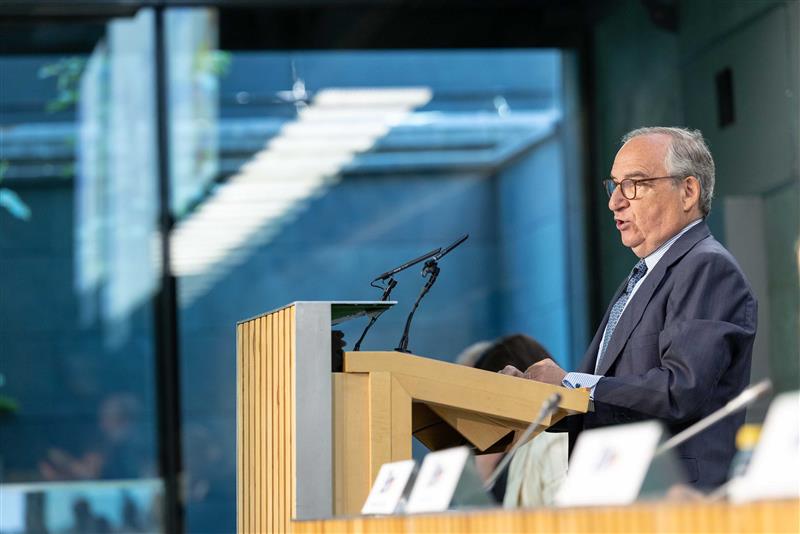
The Chairman opened his address by recalling that 2025 was the first year of the new Strategic Plan 2025–2027 and that the Group achieved the main objectives set for this initial phase: consolidating profitability at levels above those prior to the divestment of certain businesses, reducing debt, reinforcing the Group’s specialization, and maintaining a solid return for shareholders. All of this was accomplished in a year he described as record-setting for Ebro, with an adjusted EBITDA of €420.6 million and a debt reduction of €63.8 million.
He then provided an overview of the key factors that shaped the fiscal year, particularly those stemming from the international geopolitical context. Among them, he highlighted the impact of U.S. tariffs on Riviana, Garofalo and Bertagni; the depreciation of the U.S. dollar; the consolidation of retail distribution; and the increased competitive pressure in the markets in which the Group operates.
He also highlighted the significant investment activity carried out during the year, with €135 million in CAPEX aimed at strengthening industrial capacity and supporting organic growth. Among other projects, he referenced investments made in Memphis, Gragnano, Avio and Communay, all aimed to support the expansion of strategic categories such as microwaveable products, fresh pasta and convenience solutions.
In the rice business, Antonio Hernández reviewed the performance of the Group’s main brands, highlighting their leadership positions in Spain, the United States, the United Kingdom, the Middle East and Canada. He also underscored the progress of new growth avenues, such as the entry of Brillante® into the fresh category, the strength of Tilda® in the microwavable segment, and the development of the Group’s presence in markets such as Ghana and Morocco.
In pasta, he reviewed the evolution of Garofalo, Lustucru, Bertagni and Olivieri, stressing the brands’ ability to maintain their positioning in a demanding environment and the role of industrial investments in supporting growing demand for fresh pasta and higher value-added products.
In the final part of his address, Antonio Hernández noted that Ebro faces a challenging 2026, marked by persistent geopolitical tensions, tariffs, logistical difficulties , the evolution of energy costs and certain auxiliary raw materials, as well as the uncertainty arising from new international conflict zones. Nevertheless, he expressed confidence in the strength of the Group’s businesses and in the ability of its management teams and professionals to once again navigate this adverse environment.
He closed his remarks with a heartfelt thank‑you to all Ebro professionals for their dedication and contribution to the results achieved, as well as to shareholders for their continued confidence, support, and loyalty.