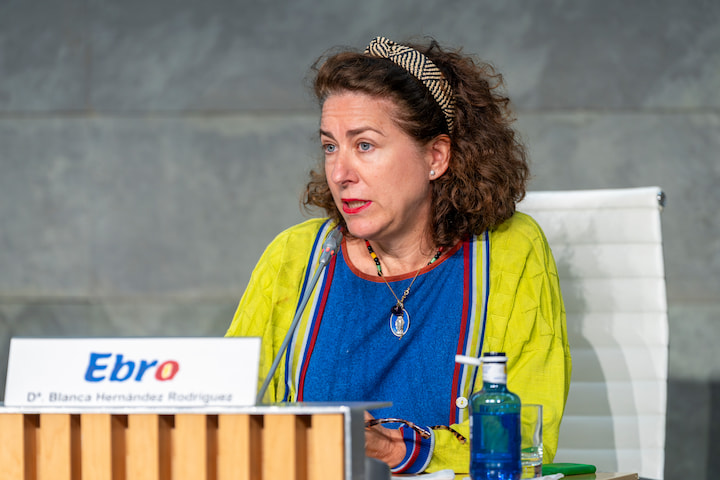
Blanca Hernández is Chair of the Ebro Foods Foundation, board member of Ebro Foods, and founder of the tuTECHÔ program, a pioneering initiative aimed at eradicating homelessness in Spain through a comprehensive solution that combines decent housing, social support, and strategic partnerships. With a solid background in the financial sector —as founding partner and CEO of Magallanes Value Investors— and board member of other companies such as PharmaMar, Blanca has driven transformative projects from the Ebro Foundation that blend social impact, innovation, and collaboration. In this interview, she talks about the origin and evolution of tuTECHÔ, the role of the Ebro Foundation in its development, and how social action can become a true driver of change.
What exactly is tuTECHÔ and what makes it different from other similar initiatives?
tuTECHÔ was born as a sustainable solution to help end homelessness. We wanted to support those who suffer the most, those who feel forgotten. We were looking for a real solution to homelessness, and to do that, we first had to understand the problem thoroughly. We realized that people don’t just need a roof over their heads: they need support, a personalized pathway to achieve full integration. That’s why our model combines housing with social support provided by nonprofit organizations because without stable housing, there is no viable life project. At the same time, support is always more effective when it starts from the dignity and stability of a home, fostering social and community integration, as well as improvements in health and well-being.
From the beginning, we knew that if we truly wanted to drive systemic change, it couldn’t rely solely on philanthropy: no one was going to give us houses, nor donate enough to acquire hundreds of them. It had to be a financially sustainable, innovative, and scalable solution. A combination of philanthropy and impact investment, capable of attracting donors and investors interested in social impact, not just economic return.
So, we brought together two worlds: business and philanthropy. We created a hybrid model made up of: tuTECHÔ Hogar, the first social enterprise listed on BME Growth, which thanks to impact investment can acquire properties and expand the stock of social housing; and the tuTECHÔ Foundation, which complements the model through philanthropy and strengthens partnerships with the third sector. Together, these two initiatives enable nonprofit organizations to provide housing and support for people in situations of extreme vulnerability, ensuring a sustainable model that allows us to scale and achieve greater impact without leaving anyone behind.
tuTECHÔ is, ultimately, an example of Humanist Economy. An innovative solution. But above all, it is a movement.An unstoppable movement of impact investors, companies, philanthropists, public administrations, and nonprofit organizations united by a firm conviction: together, we can end homelessness in Spain.
How would you define homelessness, and what should we understand when we talk about this issue?
In Spain, homelessness affects at least 30,000 people and has increased by 25% over the past decade. We’re talking about people who don’t just need a roof, they need a home from which to rebuild their lives. It is possibly the most chronic social issue in our country, and we cannot remain indifferent or wait for others to solve it.
30,000 people is a manageable number even if it were double that. I firmly believe that in a country as rich and full of opportunities as Spain, if we come together, we can put an end to this problem.
When we first started the project, we sat down with hundreds of NGOs to understand the scope of the problem and to listen to the stories behind the statistics. That’s when we learned that homelessness is not just about people living on the streets or in shelters. It’s the woman fleeing violence. The young person under state care who, upon turning 18, must leave without having anywhere to go. It’s people who fall into prostitution or trafficking, those living in substandard or unsafe housing, immigrants, refugees, asylum seekers. All deeply painful situations.
That’s why we advocate for a systemic approach, one that combines housing and social support, and addresses the structural causes of exclusion.
I’d also like to take this opportunity to highlight that homelessness is a situation, not a permanent condition. She or he is not “a homeless person”, she or he is in a situation of homelessness. That distinction is essential, because it reminds us that no one should be defined by a temporary circumstance in their life and that it could happen to any of us.
What achievements would you highlight since the launch of tuTECHÔ, and in what timeframe were they accomplished?
We’ve made remarkable progress in a very short time. In less than three years, we’ve mobilized around €60 million and acquired over 400 homes, which now house more than 3,000 people across 20 provinces in Spain, in collaboration with more than 80 social organizations. Proof that this combination of comprehensive support and housing works is that over 600 people have already transitioned to independent living. That’s why we can’t stop, the stories of people who were once so excluded and now regain joy, purpose, and autonomy are the driving force behind our growth.
Beyond the numbers, what I find most innovative is the alliance model we’ve built. Each actor contributes what they do best: companies bring expertise and resources to ensure excellence in management through their CSR; impact investors provide purpose-driven capital; NGOs support individuals on their path to integration; philanthropists offer financial resources to sustain the social fabric; and public administrations have the potential to shape policy. We all give something up to achieve a common goal: helping the most excluded members of society in Spain, those without a home. This cooperation is what has made tuTECHÔ possible. It’s a model that proves that to tackle major social challenges, we need alliances and a blend of philanthropy with business solutions, because only viable and sustainable models can scale and drive systemic change.
In this sense, we’ve shown that profit and purpose can go hand in hand. In fact, going public was a major milestone for us, not only because we were the first Spanish social enterprise to do so, but because it allowed us to democratize and raise awareness about impact investing. We want everyone to know they can help transform the world with their capital, if they invest with a focus not only on returns, but on solving real problems.
At tuTECHÔ, anyone can participate starting from just one euro. Our purpose-driven investors are so committed that we’ve just issued our first dividend and 40% of it was donated to the tuTECHÔ Foundation to further increase our impact and help even more people.
What role has the Ebro Foundation played in the development and expansion of tuTECHÔ?
It has been essential from day one. The Ebro Foundation was the one that connected us with over 300 social organizations during the year we spent deeply exploring the root causes of homelessness.
The Foundation already had a deep understanding of many of these NGOs, having supported them for years. They were our inspiration: they had proven that their model of support from within a home works. The problem was that no one wanted to rent to them, or rental costs were simply unaffordable. That’s how tuTECHÔ was born to provide housing and encourage organizations not yet using this methodology to join. In just three years, we’ve onboarded 80 social entities, 23 of which had never worked with housing before. Others had a few units, but only now have they been able to scale their model.
Today, the Ebro Foundation continues to play a key role in identifying and connecting social organizations to integrate them into the tuTECHÔ ecosystem. It is also one of the founding partners of the Techô Foundation, sits on its board, and was instrumental in its launch. Without its financial support and long-term commitment, we wouldn’t have dared to take the step of establishing it. In 2024, we officially founded it alongside a group of committed companies that actively participate in the daily management of tuTECHÔ, including EY, Renta4, Azora, Magallanes, NN, and others.
The Techô Foundation was created to support the housing program of techô hogar SOCIMI and the work of NGOs providing social support. It represents an innovative form of philanthropy that drives impact investment to scale solutions and generate systemic change. It’s a philanthropy that values the social sector, listens to its needs, and works to strengthen and energize it. We don’t want any NGO with people to support and teams ready to help to be left out simply because they can’t afford rent. We want more organizations to adopt the housing-with-support methodology, and for these processes to be comprehensive, enabling full recovery and independence for the individuals they serve. Ultimately, we aim to foster collaboration and put ourselves at the service of NGOs and their beneficiaries so that no one in Spain remains in a situation of homelessness.
And while the Ebro Foundation’s support goes far beyond financial contributions, it currently provides €100,000 annually to sponsor homes and strengthen support processes, encouraging more social organizations to join the model.
In addition, they’ve aligned their core activity—food—with the Techô Foundation, donating essential products that go directly to the homes of supported families. This ongoing commitment is a powerful example of how companies can drive real change when they align their purpose with their operations.
What role does measurement play in impact investing?
At tuTECHÔ, we understood from the very beginning that measuring impact was essential not only to be accountable to our partners, but also to assess whether what we’re doing is truly working and, most importantly, to identify where we can improve.
Thanks to this measurement, we now know that 470 children are living in our homes. What would become of them without this solution built collectively? They might be in shelters or substandard housing, without a dignified childhood. Every day, we learn from our tenants and their stories. They remind us of what truly matters: the mother who fears losing her child, the boy about to leave a care center with nowhere to go, the person who has spent far too long on the streets and feels forgotten…
Each of these stories is our greatest achievement. They reflect the real impact we strive for and the reason we continue to measure, learn, and improve.
Could you share one of those stories or a specific case that reflects tuTECHÔ’s real impact on people’s lives?
Keren was living rough in Madrid when she found out she was pregnant. After a long period of homelessness first in Barajas, then sheltering in a damp and unsafe basement, she was taken in by a social organization that supported her through a comprehensive recovery process. Thanks to that support, she was able to access a dignified and stable home from which to start anew. Her daughter was born healthy, in a safe environment, with a solid foundation. For the first time in a long while, Keren was able to find a job and begin building an independent life.
Today, she lives and works in Baltanás, a small rural town, with her partner and daughter, who now attends daycare. There, she continues her journey through the tuTECHÔ rural program, an initiative that addresses two urgent challenges: homelessness and depopulation in Spain’s “half-full” regions. The program offers a comprehensive solution that combines affordable housing, employment, social support, and community revitalization.
Keren’s story shows that, with the right support, it is possible to leave the streets behind and build a future full of opportunity while contributing to society.
What challenges does tuTECHÔ face today, and how do you plan to address them?
We face several challenges ahead, although we’re on the right path.
In Spain, there are 3.5 million vacant homes. Many of them end up being used illegally occupied without permission, turned into drug houses or overcrowded dwellings. In addition, property owners are often unwilling to rent to people experiencing homelessness.
Our challenge is to continue growing so we can acquire these homes and achieve a double return: reintegrating properties into the social housing market and helping people rebuild their lives. To do this, we must continue to attract and raise awareness about impact investing. Ensuring it’s understood and valued: as an effective tool for driving social change. There’s still work to be done to show that a social enterprise can generate dividends while transforming lives. We also need more social organizations to join this model, and for those already applying it to continue scaling. That requires more resources, more philanthropy, and public subsidies to support the social sector and enable them to take on more housing units for their support programs. Our stock market listing is helping us grow, and the Ebro Foundation and Techô Foundation are helping more organizations adopt this model.
On another front, Spain’s housing crisis is making things more difficult. The shortage of affordable housing makes it increasingly hard to offer sustainable social rentals. Recovering vacant homes, renovating them, and putting them back on the market at prices around 30% below market value requires strong partnerships. But we remain convinced that, through collaboration, it’s possible. Another way to tackle this challenge is by scaling tuTECHÔ rural. Of the 3.5 million vacant homes, half are in towns that urgently need new residents to sustain local businesses, schools, and services. These homes are more affordable, and we see an opportunity to achieve a dual goal: combat homelessness and support territorial rebalancing.
Finally, we also face the challenge of building in areas where no second-hand housing is available. Our model is based on the principle of Recycle 2 Rent: rehabilitating vacant homes, improving their energy efficiency, and reducing CO₂ emissions. We promote circular economy practices and enhance community living, preventing these homes from becoming overcrowded dwellings, drug houses, or illegally occupied spaces. This allows us to permanently expand the stock of social housing.
However, in some regions, the urgency of the housing need requires us to go further, and the challenge is to build. In Níjar (Almería), where around 3,500 people live in substandard housing or shantytowns near greenhouses, tuTECHÔ Hogar has built new homes for the social organizations working with migrant populations. Thanks to this initiative—carried out in coordination with the Jesuit Migrant Service and the local council—the Cañaveral settlement was dismantled and replaced with dignified housing.
But it’s not enough. The challenge is to build more, which is not easy given current construction costs. Once again, this will require strong alliances and collaboration across public, private, and social sectors.
In your opinion, what is the solution to ending homelessness?
The only way to end homelessness is by working together. No social organization, company, or public institution can solve it alone.
A person experiencing homelessness needs a home, and support toward recovery is always more effective when it begins from the dignity and stability of a home. We need to scale and replicate this proven model, pool resources, and work from a place of trust, without egos.
We also need to invest heavily in prevention. No matter how many people we help escape the horror of homelessness, if we don’t turn off the tap, it will continue to grow. That’s why we’re strongly committed to tuTECHÔ rural as a preventive measure for those at risk of exclusion, or for those who, after a period of recovery and support, are ready to live independently. So far, it’s been a success we’re already present in nearly 30 towns with fewer than 30,000 inhabitants. But the challenge now is to keep growing and scale the model.
What message would you like Ebro Group employees to take away after learning about this project?
On one hand, as employees of the Group, I hope they feel proud. Thanks to the Ebro Foundation, this project exists and has grown. But I also hope they don’t remain indifferent. Behind every home is a life story being rebuilt, and we can all do something: donate, invest from just one euro, offer our professional services, volunteer, or simply help raise awareness of this reality. The most important thing is not to look the other way. We cannot be indifferent to the horror of homelessness.
Track Record
In just three years, tuTECHÔ has received multiple awards for its social and financial innovation. It is also the subject of various academic studies as a model for systemic change an inspiring example of how to tackle the social and environmental challenges we face today.
| AWARD / RECOGNITION |
YEAR |
| SERES Award |
2023 |
| BCorp Certification |
2023 |
| Award for the Organization with the Greatest Social Impact in the Real Estate Sector |
2024 |
| Public Leadership Award |
2024 |
| Seville Social Responsibility Award |
2024 |
| Social Impact Initiative of the Year |
2025 |
| Financial Innovation of the Year |
2025 |
| Award for the Company with the Greatest Social Impact |
2025 |
| Banco Sabadell Social Leadership Award |
2025 |
Thank you, Blanca, for opening a window into the heart of tuTECHÔ and showing us how social action when guided by vision, rigor, and commitment, can truly change the course of many lives. Initiatives like tuTECHÔ, which we support through the Ebro Foundation, reflect the purpose and responsibility that drive us as a Company. It’s important that all of us who are part of the Group understand and appreciate the positive impact we are making as a business in society.